Why Your Team Keeps Solving the Wrong Problem
Eric Markowitz
June 30, 2026
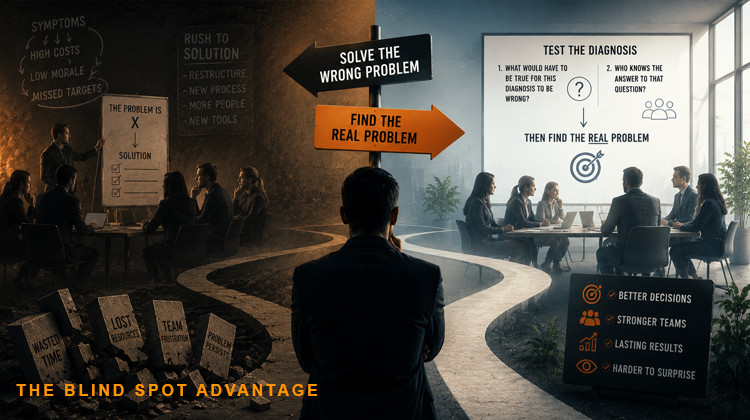
There's a pattern I've seen in every organization I've worked with, regardless of size, industry, or how smart the people in the room are.
A problem surfaces. The team convenes. Someone proposes a solution. The room coalesces around it. Resources are committed. Work begins.
Six months later, the problem is still there — sometimes worse. And the team is confused, because they worked hard, executed well, and did exactly what they said they would do.
The issue was never execution. It was that nobody stopped to ask whether the problem they were solving was actually the problem they had.
The Diagnosis Trap
Every solution contains a hidden diagnosis. When you restructure a team, you're diagnosing an organizational problem. When you hire, you're diagnosing a capacity problem. When you change the messaging, you're diagnosing a communication problem.
The diagnosis almost always happens implicitly — in the first five minutes of the meeting, before anyone has asked a single clarifying question. Someone names what they think the problem is, and from that moment forward, the entire conversation is about solutions.
A solution committed to before the diagnosis is tested isn't a decision. It's a guess wearing a business plan.
The trap is that the implicit diagnosis feels obvious. Of course the problem is X — look at the symptoms. But symptoms are almost never the problem. They're the signal that a problem exists somewhere upstream, in a place the team hasn't looked yet.
What's Actually Happening
When a team moves from symptom to solution without stopping to test the diagnosis, three things are almost always true.
First, the most politically comfortable explanation has been chosen, not the most accurate one. Blaming process is safer than questioning strategy. Blaming execution is safer than questioning the original decision. The diagnosis that survives the room is usually the one that threatens the fewest people in it.
Second, the people closest to the actual problem weren't consulted. The diagnosis came from the people with the most power, not the most information. These are rarely the same people.
Third, the previous solution was built on the same unexamined diagnosis. Which is why this is the second or third restructure, the second or third messaging overhaul, the second or third attempt to fix the same recurring issue.
The Question That Breaks the Pattern
Before your team commits to any solution, ask this:
What would have to be true for this diagnosis to be wrong?
Not "is this diagnosis wrong" — that question is too easy to dismiss. What would have to be true for it to be wrong? That question forces the room to engage with the possibility seriously, to name the evidence that would change the conclusion.
If nobody can answer it, the diagnosis hasn't been tested. It's been assumed.
The team that can articulate why it might be wrong is the team that's actually thinking. The team that can't is the team that's already decided.
The follow-up question is equally important: who in this organization knows the answer to that question, and have we talked to them?
What Changes When You Do This
The first time you run this process in a room, it feels slow. It feels like you're questioning things that don't need to be questioned. Some people will be frustrated by it.
By the third time, it becomes the fastest way to make a decision — because you're no longer backing out of solutions six months later when the underlying problem reasserts itself. You're spending thirty minutes on diagnosis instead of six months on the wrong fix.
The leaders who build this habit don't just make better decisions. They build organizations that are genuinely harder to surprise — because they've practiced seeing around corners before committing to a direction.
That's the whole advantage. Not seeing everything. Just seeing the thing you weren't looking at.
Eric Markowitz
Founder · HERO Business Coaching
Eric has spent more than twenty years walking into rooms where smart, well-intentioned teams had stopped asking the most important question. The Blind Spot Advantage is the framework he applies in every engagement.
Apply the Framework
What's the blind spot in your room right now?
The Blind Spot Advisor applies this framework to your specific situation — the question nobody on your team is willing to ask.
Start Your Free 15-Day Trial →No credit card required · From $9.95/month